Most people think aging is inevitable, like the weather. We used to think that too, until it became clear that aging is driven by biology that we can now understand, measure, and begin to control.
Today, we’re sharing why we started HexemBio, what we're building, and why this moment feels different from the decades of longevity science that came before it.
An unconventional way of treating aging
The dominant framing in aging research goes something like this: cells accumulate damage over time, epigenetic programs drift, tissue function declines. Intervene at any number of points, clear senescent cells, reset methylation patterns, inhibit mTOR, and you might slow the process.
This framing isn’t wrong, but we now know there is another less-conventional path to resist aging .
When you trace where most of the inflammation driving systemic aging originates, you keep arriving at the same place: the blood. Specifically, the hematopoietic stem cells (HSCs) in the bone marrow, the cells responsible for producing every blood and immune cell in your body. Not just red blood cells, but white blood cells, platelets, and the full immune repertoire: T cells, B cells, myeloid cells – the infrastructure that keeps infection, cancer, and inflammation in check.
As HSCs age, they change character. Research published across multiple labs has shown they shift output toward myeloid cells at the expense of lymphoid cells, weakening adaptive immunity. They accumulate mutations through clonal hematopoiesis. They produce chronic low-grade inflammation, what researchers call "inflammaging," that circulates system-wide.
That signal reaches the brain, the skin, the organs. It doesn't stay in the blood.
The connection between HSC aging and systemic decline has been documented across multiple model systems. Heterochronic parabiosis experiments showed this decades ago: young blood helps old tissue, and old blood hurts young tissue.
Whatever the precise mechanism, the signal originates in the blood system, and the blood system is where we believe intervention must begin.
And today, there is no approved therapy that directly addresses this. You can manage the downstream consequences: treat the infection, transfuse the blood, suppress the inflammation. But reversing the dysfunction in the stem cells themselves? Nobody had a real approach until now.

Where the idea came from, and why it's different
The founding team came from synthetic biology, clinical medicine, AI, and drug development.
The observation we kept coming back to was: HSCs do not begin their lives in the bone marrow. Early blood formation is initiated in the yolk sac, and as development progresses, their destiny is shaped by a series of developmental cues that provide highly specialized signals supporting their regenerative capacity. When HSCs eventually migrate to the bone marrow after birth, that formative environment disappears. And over decades without it, the cells age.
Our question was: what happens if you give aged HSCs that environment back?
Many rejuvenation approaches attempt to engineer the cells. They ask them to step away from what they are and return to a more primitive state, only to be guided forward again. While powerful, this process can be disruptive; the cell passes through stress, and something of its original identity is often lost along the way.
What we do is softer: we bring the cell back to an earlier environment, the niche where it first emerged and was shaped, and allow it to recover. We are not overwriting the cell. We are restoring it, giving it back the conditions that can help reawaken something it has not lost entirely, but forgotten.
This idea is analogous to Ellen Langer’s counterclockwise study, where elderly individuals showed measurable improvements simply by being placed in an environment that reflected an earlier stage of their lives.
We are applying the same principle at the cellular level. A patient's own cells are collected, exposed to this developmental environment, then are returned through a standard IV. From that environment, we have learned to gather the signals it releases and the patterns it holds, and condense them into an injectable that is a portable memory of the youngest place the cells once knew.
The best way I've heard it described: less like surgery, more like a very targeted spa. You come out the same person, but functioning like you did at a different point in your life.
Our co-founders’ first publication, in Nature, validated the technology itself. It established that the Synthetic Human Yolk Sac authentically recreates the developmental environment where blood stem cells are born and has the architecture, the molecular signals, and the cell types. And when our team compared the cells produced in the platform to actual human yolk sac tissue, the molecular match was so statistically tight it ruled out coincidence entirely.
Under the leadership of our co-founder, Mo Ebrahimkhani, we developed the technology to harness this early blood-forming environment to rejuvenate aged stem cells. The preclinical animal data has been reproduced across independent cohorts. Our work is protected across 15-plus patents filed with the USPTO, and the mechanism of action is the subject of our second paper, currently under review.
The procedure, and where we're taking it
The process has three steps:
- A patient's HSCs are mobilized and collected through outpatient visits
- The cells are exposed to the Synthetic Young Niche-like extract outside the body
- They're returned through a standard IV infusion
One of our long-term commitments is to the delivery system. The most impactful treatments in history are the ones that are simplest to administer, the ones that can go anywhere and reach anyone. We're working on simplifying our therapy into a single injectable. The goal is for these therapies to be accessible to anyone, anywhere, for over 100 hematological diseases.
Our lead program targets improvement of bone marrow transplant outcomes in blood cancer patients. But HSC aging connects to a broad range of disease mechanisms across immunity, neurodegeneration, organ decline, and infection susceptibility. If you could extend the number of healthy, active years people live, not just their lifespan, it would dramatically improve how they age.
The team
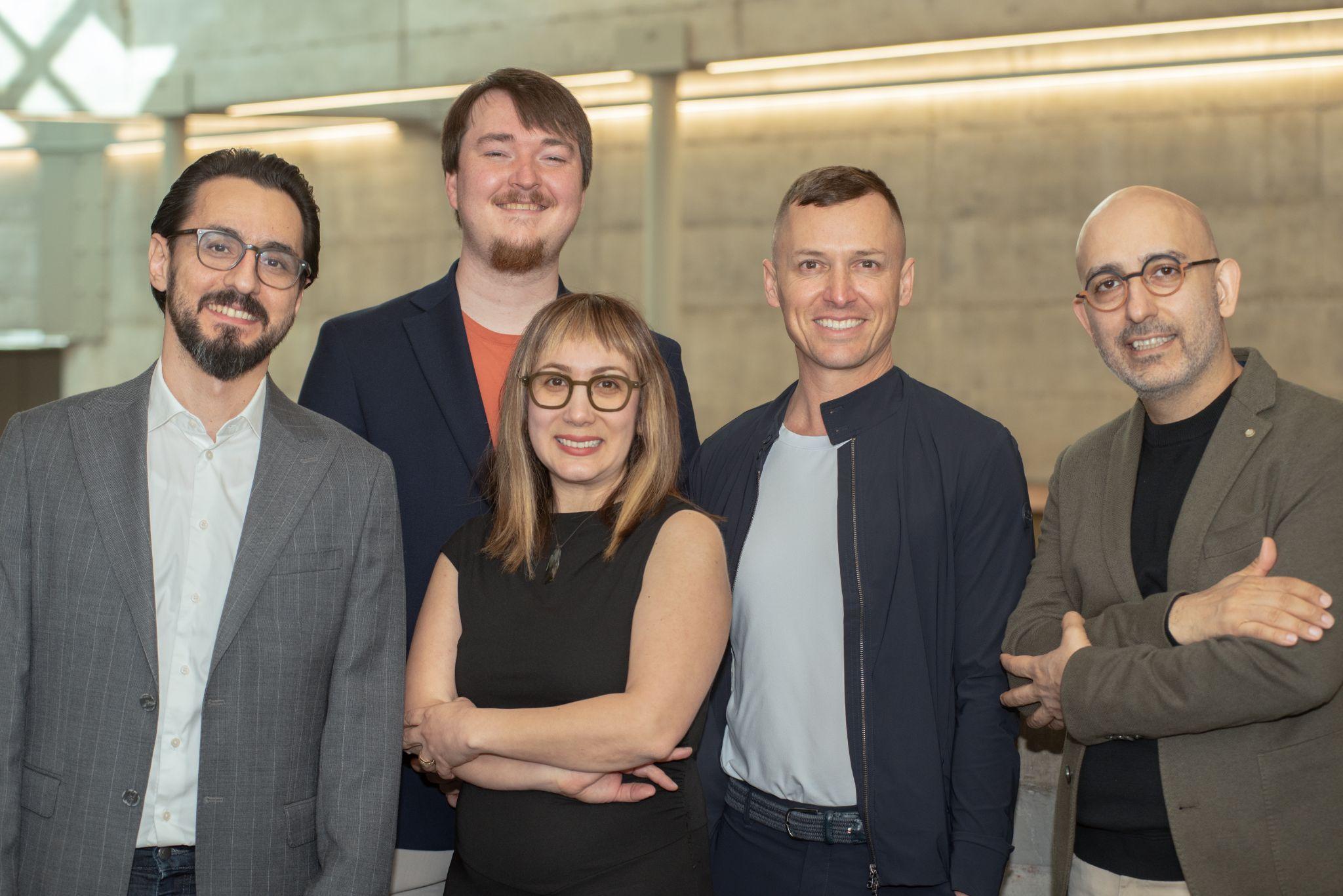
A decade ago, Gabriel was at UC Berkeley and Samira and Mo were at MIT, where all three became collaborators on Synthetic Biology, CRISPR, and Cell Therapy topics. Over years of working together across research, scientific events, and shared projects, our careers led to a DARPA Young Faculty Award, Nature Papers and U.S. Presidential awards for incredibly innovative science with high potential to change the world we live in.
Every founding team member knew at least one other for a minimum of five years before we started HexemBio.
Gabriel Levesque Tremblay (CEO and Co-Founder), Former YC founder and UC Berkeley trained, with his background spanning working on technology businesses on Wall Street and AI in Biotech. He leads HexemBio's regulatory acceleration strategy and institutional fundraising.
Mo Ebrahimkhani (CSO and Co-Founder), MD: MIT-trained scientist, inventor of the core technology, and the driving force behind its translation to human regenerative medicine and rejuvenation. A pioneer of synthetic developmental biology supported by NIH, NSF, and major foundations.
Samira Kiani (CTO and Co-Founder), MD: MIT-trained scientist, recipient of the U.S. Presidential Early Career Award for Scientists and Engineers among other awards. Leads our technology asset portfolio, including their clinical translation.
Joshua Hislop (AI Lead and Co-Founder), The first author of the pivotal Nature study. Works at the intersection of AI and biology while leading the computational tools that give us molecular-level insight into what our technology is doing to the cells.
Samet Yildirim (CBO and Co-Founder), Former YC founder, drug development and commercialization experience from Boehringer Ingelheim. He understands the payer landscape, hospital economics, and manufacturing realities that determine whether a therapy actually reaches patients.
The advisory board
We wanted high achievers, strategic thinktanks, scientific pioneers that have a track record to bring medical innovation under rapid approval with the FDA.
Robert Langer (MIT Institute Professor and Co-Founder of Moderna): Widely regarded as one of the most influential engineers in modern medicine, he is among the most cited researchers in engineering history. His pioneering work in drug delivery, biomaterials, and controlled release systems laid much of the scientific foundation that has enabled today’s advances in cell and gene therapy.
George Church (Professor of Genetics at Harvard Medical School and core faculty member of Wyss Institute): A world renowned visionary and pioneer of modern genomics and synthetic biology, his work has shaped fields ranging from gene editing and genome sequencing to gene therapy and aging. His research has long explored the frontier of engineering biology to address age-related disease and extend human healthspan.
Peter Barton Hutt (Former Chief Counsel at FDA and Former Moderna Board Member): He knows what it takes to move a therapy through the regulatory system from the inside.
Joanne Kurtzberg (Leading Bone Marrow Transplant Clinician at Duke University): She performed the first unrelated cord blood transplant in the world in 1993, building on earlier sibling-donor transplants to demonstrate that cord blood from an unrelated donor could successfully treat blood cancers. She pioneered the use of allogeneic cord blood transplants for metabolic disorders including Krabbe disease and Hurler syndrome, and later advanced autologous cord blood therapies for neurological conditions including cerebral palsy and autism. She established the Carolinas Cord Blood Bank at Duke in 1998.
David Harris (Founder of the first cord blood bank in the USA at the University of Arizona): He was the first to collect, process, and store umbilical cord blood stem cells, beginning with those of his own son. He went on to found Cord Blood Registry, now the world's largest private cord blood bank.
Felipe Sierra (Former Director of the Division of Aging Biology at the National Institute on Aging and Former Chief Science Officer at Hevolution): He has funded enough aging science to know what real progress looks like versus noise.
Jens Nielsen (CEO of BioInnovation Institute, backed by the Novo Nordisk Foundation): His perspective on what we are doing at the synthetic biology and manufacturing level is invaluable.
Daniela Bezdan (Genomics and Computational Biology Expert): She specializes in multi-omics analysis and systems-level understanding of human health and disease in extreme environments such as microgravity in space.
How we're entering the clinic
Aging is not currently recognized as an FDA indication. There is no alignment on biomarker panels, clinical endpoint, or established pathway to run a trial against biological age.
Bone marrow transplantation is risky at least 30% of the time and can lead to life-threatening complications for patients. The underlying mechanism is exactly what our technology addresses: specifically exhausted HSCs that cannot engraft, cannot reconstitute the immune system and often cannot sustain multilineage blood production.
The FDA granted us Orphan Drug Designation in July 2025. We completed our Pre-IND meeting in January 2026. Our IND is on track for submission in 2026, with the First Patient Dose (FPI) targeted after the IND approval in Q1 of 2027. Orphan designation provides regulatory and commercial advantages. More importantly, a successful Phase I trial generates human safety data on our HSC rejuvenation platform – data that directly supports a future IND for broader aging indications.
Why we've raised
We closed a $10.4M seed round led by Draper Associates, with participation from SOSV, Seraphim VC, and other strategic investors.
"HexemBio discovered a way to renew a patient's own stem cells rather than chemically or genetically reprogramming them. That kind of foundational biological innovation is exactly the type of high-conviction investment we look for."
Tim Draper, Founding Partner at Draper Associates
“We’ve spent years closely monitoring the intersection of life sciences and space. When we met HexemBio we immediately knew the time was finally right! What impressed us first was the rigor of their clinical approach: The preclinical data is among the most compelling we’ve seen at this stage, and the regulatory groundwork is already in place. The opportunity to further strengthen such a platform through microgravity‑enabled research is the cherry on the cake, exciting upside.”
Andre Ronsoehr, Partner at Seraphim Space
“As an early investor in HexemBio, I believe the next era of medicine will be built on restoring biology rather than overriding it. HexemBio's approach to blood stem cell rejuvenation reflects exactly that direction – working with the body's own developmental systems instead of engineering around them. What's equally compelling is how fast the team has validated that bet: Nature publication, Orphan Drug Designation, and Pre-IND cleared. We see this as foundational work in how the field will come to think about aging."
Stephen Chambers, General Partner at SOSV
“At Treeo VC we back AI-native companies at the earliest stage, and HexemBio sits at exactly that intersection, a team that has woven AI into the core of how they understand and engineer biology. What drew us to HexemBio was the rigorous published science backed by a rare combination: Gabriel, Samira, Mo, Samet, and the team bring together synthetic biology, clinical medicine, AI, and drug development under one roof, the kind of diverse, deeply collaborative founding team that actually moves a breakthrough from the lab into the clinic. That kind of diversity isn't incidental, it's what makes the science stronger and the therapy more likely to reach the people who need it. A Nature publication and Orphan Drug Designation this early tells you the team executes. We love working with them and are proud to be part of their journey.”
Arzu Tekir, General Partner at Treeo VC
We are at the beginning of translating this technology into human studies, starting with defined clinical needs and expanding toward broader applications in aging biology.
For the first time, we believe it may be possible to intervene at the level of the system that drives aging, not just its consequences.

